How to Get Corrective Lenses in Your Favorite Audio Frames
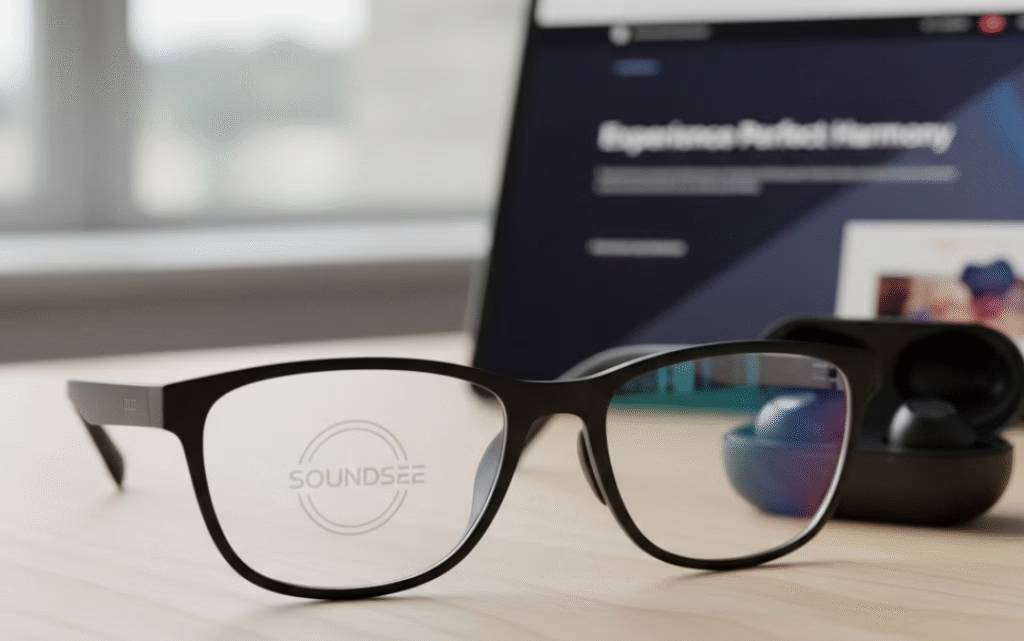
I. Introduction: No Need to Choose (The Hook)
A. The Challenge: Validate the common concern: “Do I have to wear contacts or carry two pairs of glasses?”
B. The Good News: State clearly that almost all major audio frame brands (Bose, Ray-Ban Meta, Solos, etc.) are prescription-ready.
C. Solution Roadmap: Introduce the three main pathways to getting Rx lenses installed: Manufacturer, Online Specialists, and Local Optician.
II. Pathway 1: Ordering Directly from the Manufacturer or Authorized Retailer (Easiest Method)
This is the cleanest, easiest, and often safest route for maintaining the warranty.
A. Ray-Ban Meta Smart Glasses:
Process: Order directly from Ray-Ban.com, Meta.com, or authorized retailers (like LensCrafters).1
Benefit: The process is seamless, built directly into their checkout, and the warranty remains intact.
Options: Offer a wide range of lens types (clear, sun, Transitions, blue-light filtering, progressive).2
B. Solos Smart Glasses:
Process: Solos offers direct customization when purchasing on their website, acting as a one-stop-shop for both the frame and the lenses.
C. Other Brands (e.g., Nuance Audio): Highlight that some brands are designed to be prescription eyewear first (often covering hearing and vision), simplifying the process.
III. Pathway 2: Using Online Lens Specialists (Best for Value)
Online optical services often specialize in lens replacement for smart frames.3
A. Key Players & Brands Supported (Use Search Data):
Mention online vendors like GlassesUSA.com, Lensabl, LensesRx.com, or UseMyFrame.com that specifically advertise services for brands like Bose Frames or Ray-Ban Meta.4
Highlight that these companies offer competitive pricing (e.g., some single vision lenses for Bose Frames start around $50 – $60 + cost of the frames).
B. How it Works (The Two Options):
Option A: Ship-In: You mail your existing audio frames to the specialist, and they professionally install the lenses and mail them back (often recommended).
Option B: DIY Pop-in: They mail you the custom-cut lenses, and you install them yourself (requires care, but saves time).
C. Critical Requirement: Emphasize the reader will need a valid, up-to-date prescription and their Pupillary Distance (PD) measurement.
IV. Pathway 3: Visiting a Local Optician (Best for Complex Prescriptions)
A. When to Use This: Ideal for complex prescriptions (high-index lenses, strong progressives, unique prism) or if the runner wants to use their Vision Insurance/FSA/HSA benefits.
B. The Process: You purchase the empty or non-Rx audio frames and take them to your local optical shop (e.g., an independent shop, or an in-store provider like LensCrafters/Target Optical).
C. Important Notes & Warnings:
Warranty Risk: This may void the manufacturer’s warranty on the frame, as they did not install the lens. Reader must check the frame warranty.
Frame Compatibility: Confirm that the frame material/design is suitable for the prescription (some very curved sport frames cannot accommodate certain strong prescriptions).
V. Essential Checklist Before Ordering
Use a quick-reference table for the reader.
| Step | Detail |
| 1. Get a Current Rx | Ensure your prescription is less than 1–2 years old (check state laws). |
| 2. Get PD | Note your Pupillary Distance (PD)—the most critical measurement for online ordering. |
| 3. Check Warranty | Confirm if using a third-party vendor voids the audio frame’s warranty. |
| 4. Choose Lens Type | Decide on the specifics (Single Vision, Progressive, Polarized, Transitions, Blue-Light Filter). |
| 5. Plan Budget | Lenses often cost $100 – $300+ on top of the frame price, depending on coatings and strength. |
VI. Conclusion and Next Step
Final Summary: Reiterate that modern audio glasses are designed to serve as a user’s primary eyewear, making the Rx process straightforward.
Call to Action (CTA): Lead them back to your product review now that the prescription question is answered.
➡️ Next Step: Ready to find the perfect pair? See our comparison of the best audio glasses that are 100% Prescription Ready.